Maintaining a responsive braking system is the most vital safety requirement for navigating the busy intersections and highways of Troy, Michigan. Whether you are commuting along Big Beaver Road or driving through local neighborhoods, your ability to stop quickly determines the safety of your passengers and other motorists.
Ignoring the early warning signs of brake wear can turn a simple pad replacement into a costly and dangerous mechanical failure. By staying vigilant and recognizing the symptoms of declining brake health, you can ensure your vehicle remains reliable throughout every season.
Audible Warning Squeals and Grinding
Modern brake pads are designed with a small metal shim called a wear indicator that produces a high-pitched squeal when the friction material gets dangerously thin. If you ignore this sound, it will eventually evolve into a harsh, metallic grinding noise that indicates the pads are completely gone.
- Listen for a persistent chirping or squealing sound that disappears when you apply the brakes.
- Watch for a deep “growling” sound, which suggests metal-on-metal contact between the caliper and the rotor.
- Pay attention to any screeching that occurs during slow-speed stops in parking lots.
Once you hear grinding, your rotors are likely being damaged beyond the point of resurfacing. Addressing the noise at the “squeal” stage is the most cost-effective way to maintain your stopping power.
Vibrations and Pulsing Through the Pedal
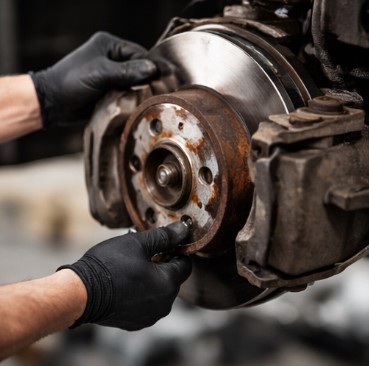
If you feel a rhythmic shaking or pulsing in the brake pedal when slowing down from highway speeds, it is often a sign of warped brake rotors. In the variable climate of Troy, the rapid heating and cooling of the metal can cause rotors to lose their perfectly flat surface.
- Notice if the steering wheel shudders, specifically when the brakes are engaged.
- Feel for a “thumping” sensation that increases in frequency as your vehicle’s speed increases.
- Observe if the vibration is more pronounced during heavy braking on steep inclines or exits.
Warped rotors reduce the contact area between the pad and the disc, significantly increasing your stopping distance. Smoothing or replacing these components is essential for a smooth and predictable braking experience.
Spongy or Soft Brake Pedal Feel
A brake pedal should feel firm and provide immediate resistance when pressed; if it feels “mushy” or sinks to the floorboard, you have a serious hydraulic issue. This symptom often points to air in the brake lines or a failing master cylinder that can no longer hold pressure.
- Test if you have to “pump” the brakes several times to get the vehicle to come to a complete stop.
- Watch for a pedal that slowly sinks toward the floor while you are holding it at a red light.
- Check the ground beneath your car for clear or amber-colored fluid that feels oily to the touch.
A soft pedal is an immediate safety hazard that could lead to total brake failure without warning. If your brakes lose their firmness, the vehicle should be inspected by a professional before your next trip.
Vehicle Pulling to One Side
When you apply the brakes, your car should continue to travel in a perfectly straight line. If the vehicle “tugs” or pulls the steering wheel to the left or right during deceleration, you likely have a stuck brake caliper or a collapsed brake hose.
- Monitor if you have to fight the steering wheel to keep the car centered while stopping.
- Check for uneven heat radiating from your wheels after a drive, as one side may be much hotter than the other.
- Look for uneven wear on your brake pads, where one side is significantly thinner than its counterpart.
This pulling effect is not only frustrating but can be dangerous during emergency maneuvers or on slippery Michigan winter roads. Correcting the balance of your braking system ensures even wear and stable handling.
Pungent Burning Smells and Overheating
A sharp, chemical burning odor coming from your wheels after heavy braking is a sign that your brakes are overheating. This is common if a brake caliper has seized “shut,” causing the pads to constantly rub against the rotor even when your foot is off the pedal.
- Be aware of a smell similar to burning carpet or acrid smoke near the wheel wells.
- Look for a blue or “glazed” tint on the surface of the rotors, which indicates extreme heat exposure.
- Avoid driving if you see actual smoke, as the brake fluid could reach its boiling point and fail.
Overheated brakes suffer from “brake fade,” a condition where the friction components lose their ability to grip the rotor. Allowing the system to cool and replacing the stuck components is the only way to restore safety.
Prioritizing Your Safety on Michigan Roads
Your brakes are the most important safety feature on your vehicle, and they require consistent attention to perform at their best. By recognizing the sounds, feels, and smells of brake wear, you can take proactive steps to protect yourself and your family during your Troy commute.
Proper maintenance doesn’t just save you money on extensive repairs; it provides the peace of mind that your car will stop exactly when you need it to. Don’t take chances with your stopping power—address these signs early and keep your vehicle in peak condition for the road ahead.